
Beyond the Ban: How Modern Tech Companies Bring Shadow AI Under Real-Time Control
A practical playbook for discovering Shadow AI, setting clear policies, and protecting company data in real time without blanket bans.
Walk into almost any growing company today, and you will find employees quietly getting help from artificial intelligence.
A marketing manager uses a public chatbot to tighten a strategy deck. A developer pastes an error trace into a personal coding assistant to debug a release. A customer success representative pastes a frustrated user’s email into a browser extension to draft an empathetic reply. An automated bot quietly joins a client call to transcribe the conversation.
None of these employees set out to cause a data breach. They are simply trying to get their work done faster.
The problem is that almost all of this happens outside the visibility of IT, security, and compliance teams. This is the reality of Shadow AI.
What Is Shadow AI, and Why Is It Different From Shadow IT?
Security teams have managed unauthorised software for decades under the banner of Shadow IT (such as unsanctioned Dropbox folders or unvetted SaaS tools).
Shadow AI is the use of AI tools or AI-enabled features within an organisation without formal organisational approval, visibility, or security controls.
While it shares root causes with Shadow IT, Shadow AI represents a fundamentally higher risk category.
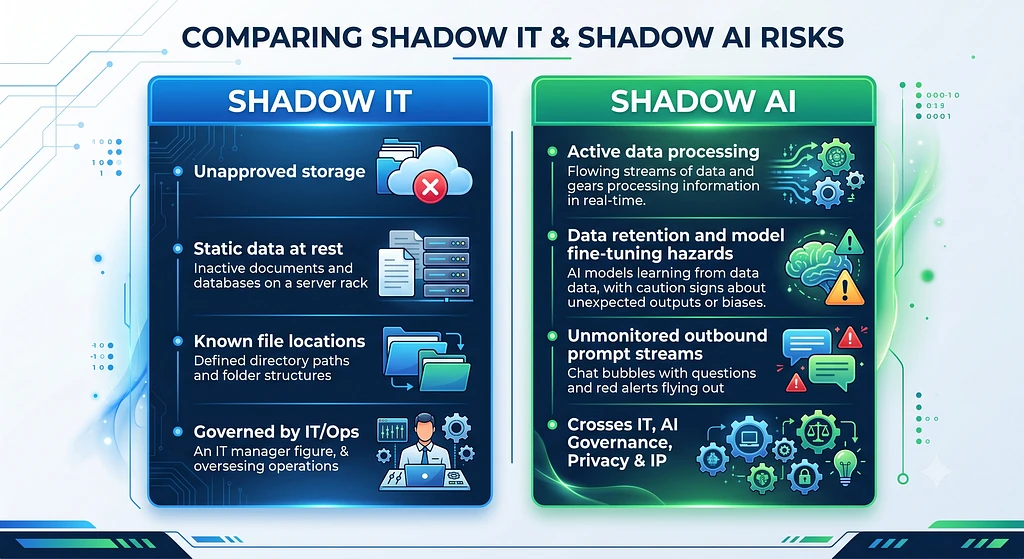
With traditional Shadow IT, files are stored on an external server you don’t manage. With Shadow AI, your company’s data is actively ingested, parsed, and interpreted by third-party model architectures — often under free-tier consumer terms that reserve the right to retain prompts or use submitted data for model improvement.
The Six Common Everyday Leaks
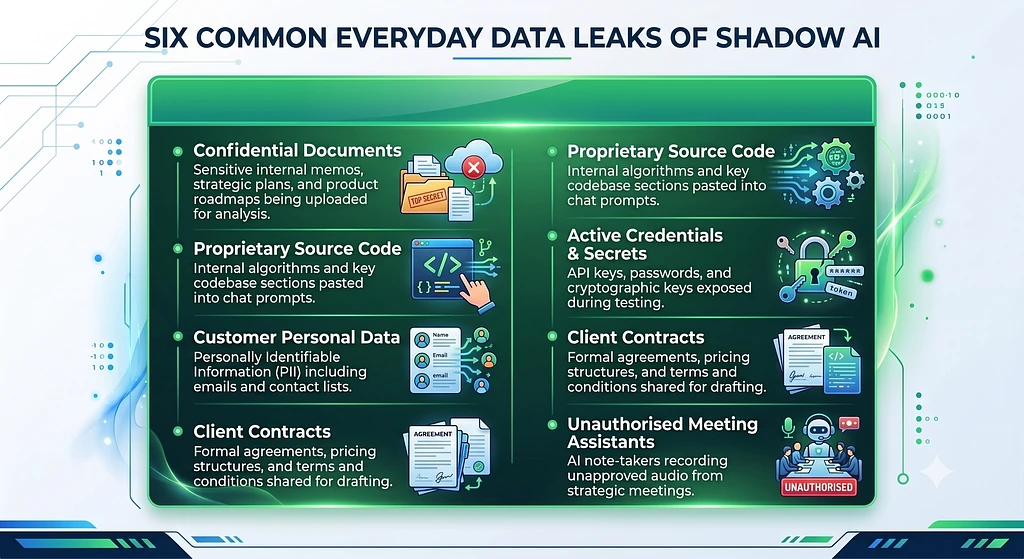
Shadow AI does not typically announce itself with a dramatic server breach. It operates as a slow, distributed trickle of confidential data, leaving your environment one prompt at a time:
- Confidential Documents: Strategic decks, board notes, and quarterly budgets uploaded to public chatbots for instant summaries.
- Proprietary Source Code: Internal algorithms, unreleased features, and database schemas pasted into personal IDE extensions.
- Customer Personal Data (PII): Support reps pasting customer names, emails, and transaction histories into AI text editors.
- Active Credentials & Secrets: Engineers copying raw server logs containing live API tokens, bearer keys, and internal IP addresses.
- Client Contracts: Sales or legal reps uploading signed customer contracts with strict third-party confidentiality clauses.
- Unauthorised Meeting Assistants: Third-party transcription bots are recording confidential client meetings without verified consent.
Why Blanket AI Bans Always Backfire
When leadership first realises how widespread unsanctioned AI use is, the instinctive reaction is often: “Block all AI domains at the firewall.”
This approach almost always fails in practice:
- It Breeds Workarounds: High-performing employees under tight deadlines do not stop using AI; they switch to personal laptops, mobile hotspots, or unlisted browser extensions that bypass corporate firewalls.
- It Destroys Engineering Velocity: Restricting modern development and research tools puts your company at an immediate disadvantage compared to competitors that are safely adopting AI.
- It Creates a False Sense of Security: A network-level domain block gives leadership the illusion of control while driving real adoption deeper underground.
As cybersecurity and AI governance standards emphasise, “You cannot govern what you cannot see.”
The sustainable path is not a blanket ban; it is controlled, real-time AI governance.
The Real-Time Governance Playbook with Zotniq
To bring Shadow AI into the light without slowing down your teams, organisations need runtime data protection at the device boundary.
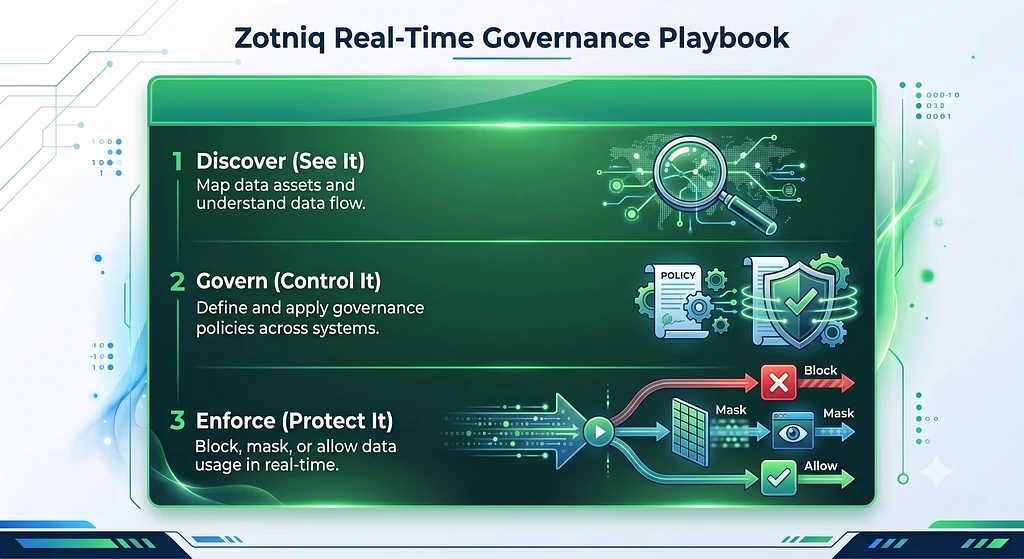
Zotniq provides a real-time AI data-exposure prevention layer that delivers complete visibility and automated protection in three coordinated steps:
1. Discover (See It)
Within 15 minutes of deployment, Zotniq maps your entire organisational AI footprint:
- Which public chatbots, browser extensions, desktop apps, and IDE plugins are your teams actually using?
- Who is using them, how frequently, and what categories of company data have been exposed.
2. Govern (Control It)
Rather than writing complex code or rigid network rules, administrators set plain-language policies directly on the Zotniq platform:
- “Block all submissions of live API keys, internal credentials, and database passwords.”
- “Automatically mask customer PII (names, emails, phone numbers) before prompts reach external models.”
- “Allow clean source code and standard technical queries across approved AI tools.”
3. Enforce (Protect It in <10ms)
Zotniq’s lightweight runtime engine evaluates outbound prompts in single-digit milliseconds right on the employee workstation:
- BLOCK: Stops live credentials, secret keys, or unvetted tools instantly before a single byte leaves the machine.
- MASK: Automatically replaces sensitive customer records and internal variables with format-preserving synthetic tokens. Employees get the AI answers they need without leaking private data.
- ALLOW: Permits safe, approved technical and business queries to flow through with zero developer friction.
Aligning with ISO 42001, ISO 27001, and Privacy Mandates
Bringing Shadow AI under real-time governance directly satisfies the core requirements of modern security and compliance frameworks:
- ISO/IEC 42001 (AI Management System): Fulfils requirements for maintaining an accurate AI system inventory, establishing AI acceptable-use policies, and enforcing continuous data governance.
- ISO/IEC 27001 (Information Security): Brings unapproved data transfers, supplier risk, and asset handling under formal ISMS controls (Annex A.8.12 Data Leakage Prevention and A.5.10 Acceptable Use)
- Global Privacy Standards (GDPR, HIPAA, India DPDP Act 2023): Ensure personal data is never transmitted to unassessed third-party AI processors without a verified lawful basis and data-processing safeguards.
Crucially, Zotniq achieves this with Zero Prompt Retention: audit logs record policy triggers and enforcement actions without storing sensitive raw prompts, eliminating secondary data liabilities.
Moving From Fear to Governed Adoption
Shadow AI is not a disciplinary failure — it is proof that your employees want to move faster and build better products.
The companies that win the next decade will not be the ones that attempt to turn off the future with firewall blocks. They will be the organisations that establish clear visibility, enforce automated runtime guardrails, and empower their workforce to use AI securely and responsibly.
Ready to uncover and govern Shadow AI in your organisation?
- 15-Minute Deployment: Install Zotniq across your fleet with zero code changes or proxy re-architecting.
- Immediate Exposure Audit: Receive a complete visual report of every AI tool active in your company and where your data is travelling.
Get your AI Exposure Audit or Schedule a Walkthrough at Zotniq.ai
One deep dive a month on GenAI Data Protection: engineering, policy, and what actually shipped. No spam, unsubscribe anytime.
Delivered via Substack. Unsubscribe anytime.