
When Your Intellectual Property Becomes Their Training Data: The Mid-Market AI Dilemma
How mid-market companies can protect proprietary algorithms, research, and trade secrets while enabling their teams to use AI.
For companies operating in regulated industries like fintech, healthcare, and defence-adjacent SaaS, compliance regulations and trade secret laws do not forgive “accidental AI sharing.” The moment proprietary customer data or algorithmic code crosses your perimeter, you risk failing your regulatory audits and forfeiting your legal claims to exclusive intellectual property.
In the mid-market segment — companies scaling between 50 and 2,000 employees and up to $100M in ARR — this creates an existential operational tension.
Unlike global tech giants, mid-market companies cannot afford to staff 50-person AI security teams or spend a year building air-gapped internal AI clusters. Yet their enterprise valuation rests almost entirely on proprietary algorithms, custom underwriting models, unreleased feature architectures, and unique data pipelines. To stay competitive, their engineers and data scientists are using external AI assistants daily to punch above their weight.
The recent controversy surrounding the Navier–Stokes Millennium Prize Problem serves as an urgent wake-up call for this exact market segment.
The Wake-Up Call: A World-Class Researcher’s Boundary Failure
In September 2026, OpenAI announced an AI-generated solution to the century-old Navier–Stokes existence and smoothness problem, one of mathematics’ seven $1,000,000 Millennium Prize challenges.
Hours before the announcement, NYU mathematics professor Tristan Buckmaster — one of the world’s leading authorities on fluid dynamics — released an alarming public statement:
- Buckmaster and his research team had spent years developing a breakthrough approach to the problem.
- To structure formal proofs and debug code, Buckmaster had entered preliminary research drafts and working notes into OpenAI’s developer tools.
- Buckmaster publicly questioned whether the AI model had ingested, learned from, or summarised his proprietary drafts, allowing the lab to announce a solution to the very problem he was actively researching.
The resulting Navier–Stokes priority controversy shook the global research community. But for leaders of growing 50–2,000 employee companies, the takeaway is clear:
If an elite mathematician at a top-tier research institution can inadvertently lose control of his working drafts to an unmanaged AI tool, what is happening to your company’s proprietary code, loss functions, and customer data every day?
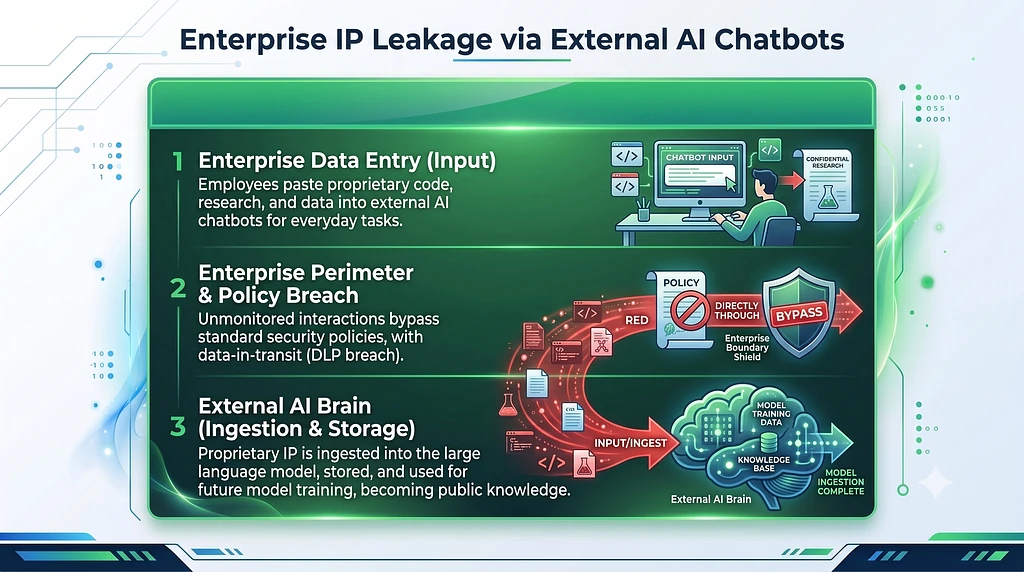
The $100M ARR Reality: You Cannot Afford the “Scratchpad” Illusion
Mid-market tech companies rarely have generic problems. Your value is driven by proprietary IP:
- Fintech & Insurtech ($10M–$100M ARR): Custom credit-scoring formulas, dynamic risk matrices, and proprietary fraud-detection heuristics.
- Healthcare & Healthtech (50–1,000 Employees): Proprietary clinical decision logic, patient workflow architectures, and diagnostic training datasets.
- B2B SaaS & Deep Tech: Novel search ranking algorithms, semiconductor place-and-route heuristics, and unreleased product roadmaps.
When an engineer or data scientist runs into a roadblock at 11:00 P.M., they treat an AI chatbot or coding assistant as a private digital scratchpad. They paste raw mathematical formulations, database schemas, and proprietary cost matrices to get an instant answer.
Architecturally, that is an unmanaged outbound data transfer.
Under trade secret law, maintaining ownership requires proving you took reasonable efforts to maintain secrecy. When employees paste confidential logic into external AI tools operating under standard commercial or consumer terms, you hand your competitors’ models the exact innovations that define your market edge.
Why the Traditional Enterprise Playbook Breaks for Mid-Market Firms
Mid-market leaders often find themselves trapped by solutions that don’t fit their scale:
- The Blanket Ban Fails: Telling 200 developers they cannot use AI simply breeds Shadow AI. Engineers switch to personal laptops and unmonitored accounts to meet deadlines.
- Legacy DLP Is Too Dumb: Traditional Data Loss Prevention tools look for static 16-digit credit cards. They cannot distinguish between general Python code and your company’s proprietary pricing algorithm.
- Rebuilding the Tech Stack Takes Too Long: A 9-month custom AI gateway project consumes engineering cycles you need for your core product roadmap.
The Zotniq Breakthrough: Natural Language IP Governance
Mid-market engineering and compliance teams need an agile way to set boundaries without dedicating months of DevOps overhead.
Zotniq enables security and technical leaders to define what constitutes their intellectual property in plain English.
Instead of configuring brittle regex patterns or writing custom code, an administrator sets plain-language policies directly within the Zotniq dashboard:
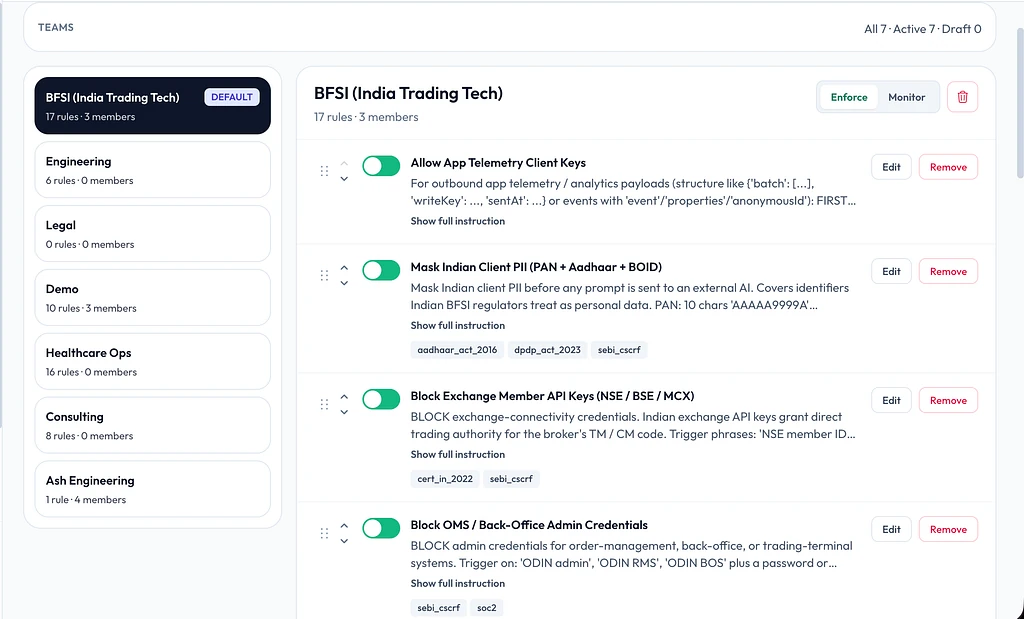
Zotniq’s runtime engine evaluates these instructions against outbound prompts with sub-10 millisecond latency.
Real-Time Protection Built for 50–2,000 Employee Teams
Operating on the principle of “Control in the Cloud, Data at the Edge,” Zotniq installs directly on developer workstations (macOS/Windows), at the network layer, or via a 3-line SDK. It inspects outbound prompts right on the device — across IDEs (VS Code, Cursor), browser tabs, and terminal agents.
Before a prompt leaves the machine, Zotniq applies three deterministic actions:
- BLOCKS Core IP Transfers: If an employee attempts to send a proprietary algorithm, an unreleased patent claim, or an internal scoring model, Zotniq terminates the transmission on the host. Zero bytes reach the third-party model.
- MASKS Contextual Secrets: If an engineer needs AI help optimising an equation, Zotniq dynamically replaces proprietary variables and codenames with structurally identical synthetic tokens. The external model helps solve the logic without ever seeing your actual trade secret.
- ALLOWS Clean Requests: General queries, syntax checks, and public framework searches proceed uninterrupted with zero developer lag.
Audit-Ready for Enterprise Due Diligence
When you are scaling to $100M ARR, enterprise buyers and auditors scrutinise your AI governance. Whether you are renewing SOC 2 Type II, maintaining HIPAA compliance, or aligning with ISO 42001, Zotniq delivers enterprise-grade proof:
- Zero Prompt Retention: Zotniq logs policy enforcement events without storing raw prompt contents or proprietary source code, eliminating secondary data liabilities.
- 15-Minute Deployment: No infrastructure rebuilds, no private cloud clusters, and no disruption to engineering velocity.
- Instant Exposure Audit: Receive a complete visual map of every AI tool used across your company and all prevented IP leaks.
Move at AI Speed Without Surrendering Your Moat
The lesson of the Navier–Stokes controversy is that treating AI tools as private scratchpads puts your most valuable innovations at risk.
For the 50-to-2,000-employee company, the answer is neither a reactionary ban nor blind trust. It is establishing clear, automated guardrails at the point of prompt creation.
By defining your enterprise IP in plain English and enforcing real-time controls, your teams can leverage the world’s most powerful AI models while ensuring your core intellectual property remains strictly inside your building.
Ready to protect your company’s core IP?
- 15-Minute Setup: Deploy across your engineering fleet with zero infrastructure changes.
- Immediate AI Exposure Audit: Discover where proprietary code, trade secrets, and internal data are currently travelling.
Get your AI Exposure Audit or Schedule a Walkthrough at Zotniq.ai
One deep dive a month on GenAI Data Protection: engineering, policy, and what actually shipped. No spam, unsubscribe anytime.
Delivered via Substack. Unsubscribe anytime.